Building for volatility: what we learned at the EiQ Global Summit in New York

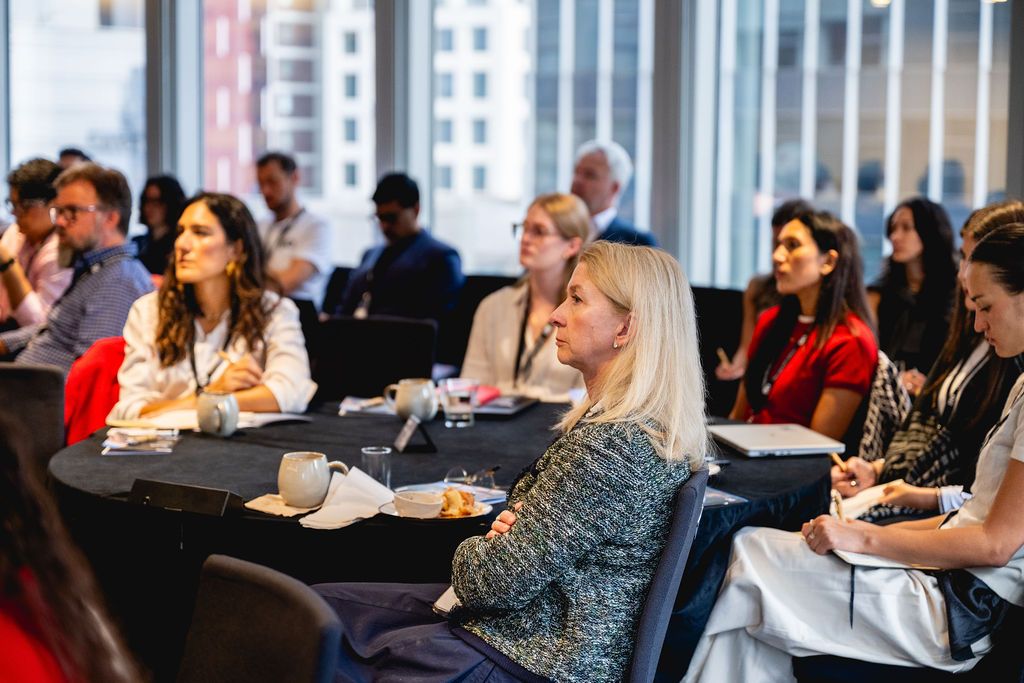
The EiQ Global Summit came to New York on 23 September 2026, following the London summit in June. Leaders in responsible sourcing, procurement and sustainability spent the morning on one question: how do you decide where risk sits, and what to do about it, when conditions change faster than your planning cycle can track them?
Two forces are already changing what risk costs
The post-war rules-based order is fracturing, and the institutions built on it are no longer able to enforce the rules they were created to uphold. Politics now sits above markets. Industrial policy and security policy intervene in commercial activity in ways that would have been unusual 20 years ago, and regionalisation is accelerating as a result. One consequence reaches due diligence teams directly: anti-corruption norms are weakening among major economies, which changes what a supplier's declarations are worth.
The environmental argument was put in the same terms. Global emissions are still rising and there is no effective carbon price in sight, but companies are already paying for climate risk through the market. Insurance costs for real estate are climbing and cover has been withdrawn in some areas, while water stress and agricultural instability are showing up in input prices. Budgeting and supplier cost assumptions built before this repricing began will understate it.
The single global standard is giving way to local adaptation
The model of one global operating standard rolled out everywhere has less purchase than it did. What works instead is adapting market by market while holding a clear global identity, which means real local government affairs and regulatory monitoring capability in each market, with core competence and brand values holding the organisation together across them.
The same shift is visible in consumption. A growing share of global consumption now sits outside the West, and the consumer brands headquartered in those markets are taking a larger role in setting expectations. That raises a question the industry has not had to ask before. Who defines the next generation of sustainability standards, and on whose terms?
In sourcing, "China plus one" – one alternative source held alongside the main one – has given way to something closer to China plus 14, with every product sourceable from several regions. None of this is cheap. Ultra-diversification requires people on the ground in each region, because managing at a distance consistently fails, and local presence is what buys first-hand information and a faster response.
Two things limit what diversification achieves on its own:
- Moving Tier 1 production does not move upstream risk with it. The picture changes far less than the sourcing map suggests once you reach raw materials and transformation.
- Leaders default to familiar suppliers on the basis of past performance, which only partly predicts how a supplier will perform when disruption sets the conditions. Long relationships deserve investment rather than abrupt exits, but not every one of them will survive the change.
The suggested response was to price supply chain risk into supplier cost models, including the potential cost of enforcement action, disruption and rework, so that supplier A and supplier B can be compared on a more honest long-term basis. The method for doing that is still being worked out across the industry.
Definitions and data come before AI
Systems built on quarterly calendars cannot run at the speed of a business driven by headlines. The maturity model set out in response has four stages:
- Manual – documents, spreadsheets and checklists, with supplier information held in different places.
- Risk-based – screening and prioritisation, so effort follows where risk is highest.
- Intelligent – data, automation and structured methodologies supporting better decisions.
- Truly dynamic – continuous risk monitoring that triggers interventions, with feedback loops that turn the programme into a learning system.
Most programmes sit somewhere between the second and the third. Moving to the fourth is the hardest step, because a programme stops supporting decisions and starts triggering them.
Getting there starts with agreeing what counts as a high-risk supplier and what counts as acceptable evidence, so the same data can answer each new regulation rather than the programme being rebuilt for it. Senior roles are now being created to own exactly those decisions.
Who is accountable when the system decides?
Annual reporting cycles are giving way to always-on compliance, with explainability built into the tooling rather than added afterwards. But when a system finds more risks, conditions are not necessarily deteriorating, and teams need educating on the difference.
The agreed principle is that whoever deploys or shares an AI-generated output is accountable for it. That principle is easier to state than to operate, and there was a clear warning against treating the human in the loop as a scapegoat. For instance, in an agentic RFP, agents select suppliers in real time across tariffs and shipping conditions, at a speed no human reviewer can meaningfully check. How accountability works in that setting is unresolved – one response gaining ground is to slow the handover of decisions to automated systems, treating that as a governance decision rather than a failure to keep up.
Gary Francis, our Chief Technology Officer, and Jaime Rua Tavira, our Head of Client Solutions, discuss what sits behind an AI-generated supplier risk score, and the questions worth asking before you rely on one, in an upcoming episode of our podcast EiQ Voices. Look out for it in our newsletter.
Global models are running the other way
The industry spent 50 years building one global model and applying it everywhere. The work now runs the other way, towards the country, the site and the people in it, and that was named as the defining challenge.
When institutions weaken, companies have to hold the fundamentals themselves, anchored on principles that survive across every culture: reciprocity, non-violence and compassion for others. In a period where organisations are adapting market by market and rule by rule, the thing that holds a company together is what it decides not to compromise on.
The NY Leadership Series 2026, LRQA's 18th annual Leadership Series, sponsored by General Motors, takes place on 26 October 2026 at 09:00 EST at the New York Stock Exchange, 11 Wall Street. The programme covers much of the ground above, including AI in responsible sourcing, forced labour enforcement and traceability, tariffs and trade, and emerging risks such as heat stress. Register here.
Related Posts
Discover more insights from our blog.

Australia's modern slavery reform: why waiting is the expensive option
Australia is consulting on a criminal offence for failing to prevent modern slavery. But the defence rests on evidence, and evidence takes time to build.

EiQ by LRQA positioned as an Innovator in the 2026 Verdantix Green Quadrant
EiQ has been positioned as an Innovator in the Verdantix Green Quadrant: Supply Chain Sustainability Software (2026) – an independent benchmark of 16 providers.

Gary Francis joins EiQ as Chief Technology Officer
EiQ has appointed Gary Francis as Chief Technology Officer, as part of a wider investment in its technology and product.